The UK's Online Safety Act passed three years ago, and TechRadar used the anniversary to ask VPN providers how it has worked. Their verdict: a heavy-handed approach that has been only partly successful. The Act gave platforms obligations to detect and remove child sexual abuse material, criminalised several specific online harms and introduced penalties for non-compliance, not all of which have been paid.
The part that mattered for the VPN industry was age verification, which landed in 2025. VPN downloads in the UK surged the moment it took effect, as users looked for ways around identity checks on adult and some mainstream sites, and VPNs became a talking point for regulators who saw them as a loophole.
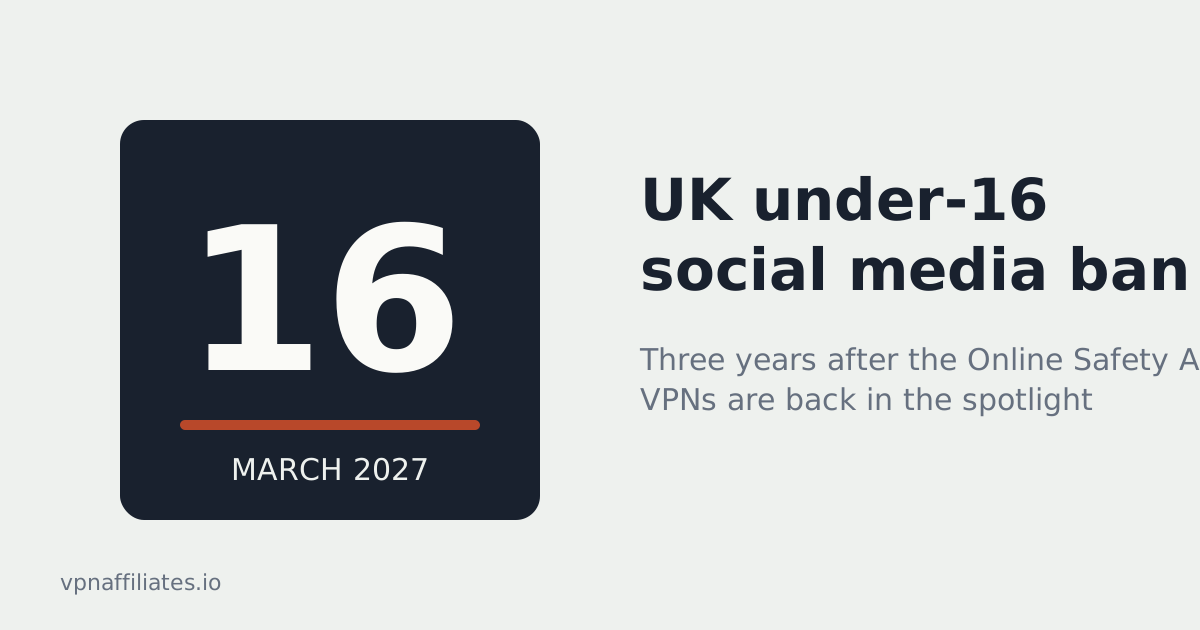
That cycle is about to repeat. Ofcom announced steps towards a ban on social media for under-16s, currently slated for March 2027. Providers quoted by TechRadar argue that repeating the same age-gating model will push more users to circumvention tools and put VPNs back under scrutiny, with the possibility of restrictions that go beyond the current regime.
Why it matters to affiliates. The 2025 age-verification rollout produced one of the biggest short-term demand spikes the UK VPN market has seen. A second wave is now on the calendar. Content that targets UK readers — explainers on how the ban works, which services are affected, and what a VPN does and does not do — can be written and ranked well before March. The programs with the strongest UK pull are NordVPN, Surfshark and Proton VPN.
There is a compliance side too. Most programs prohibit promoting VPNs as a way to break the law or to help minors evade age checks, and Proton in particular bans placement on adult sites. Copy around this story should stay on the privacy and regulation angle, not on circumvention.